
We stand on the precipice of a new era, defined not by the technology we build, but by how that technology reshapes the core of human experience and productivity. For decades, automation was about physical robots on assembly lines. Today, the conversation has shifted dramatically with the advent of generative AI, large language models, and advanced cognitive automation.
This shift has created a common anxiety: "Will AI replace my job?"
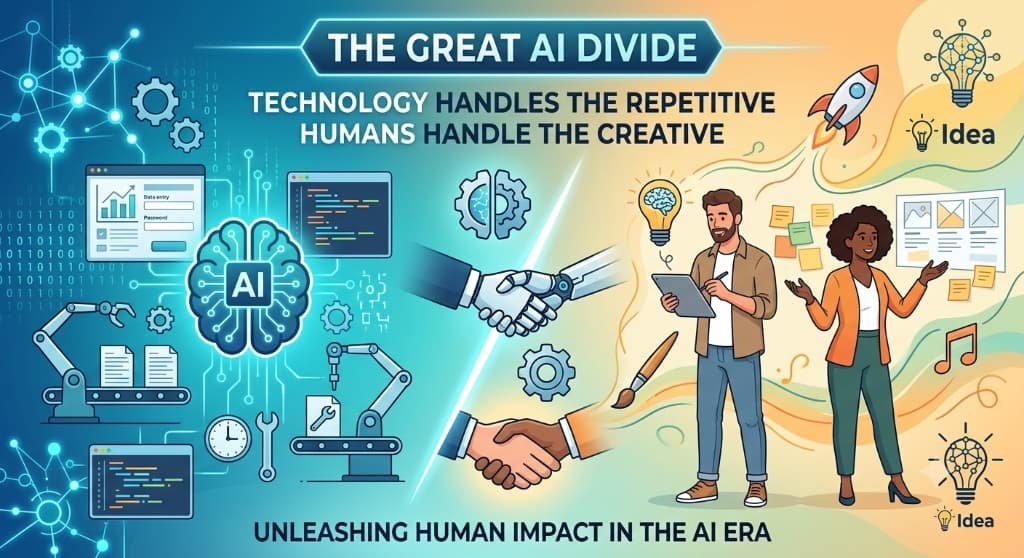
“Technology handles the repetitive. Humans handle the creative.”
The answer is complex, but it often boils down to this fundamental principle. Understanding this distinction is not just a matter of career survival; it is the key to thriving in the AI era and unlocking unprecedented impact.
The Rise of the Digital Co-Pilot: Automating the Mundane
AI and automation are our new digital co-pilots. Their superpower lies in pattern recognition, high-speed computation, and managing vast data sets without fatigue. They excel at "repetitive" tasks, which go far beyond simple data entry. In the modern context, this includes:
- Initial Drafting and Research: Gathering data, summarizing long reports, and creating first drafts of code or content.
- Predictive Maintenance and Diagnostics: Analyzing sensor data to predict machine failures or medical diagnostics based on a vast history of images.
- Customer Support (Level 1): Instantly answering FAQs and routing complex queries to the right human.
- Complex Scheduling and Optimization: Managing logistics, optimizing supply chains, and complex calendar Tetris.
By delegating these tasks, we don't just "save time." We save cognitive load. We preserve our mental energy, our focus, and our motivation—resources that are often depleted by a day of rote, uninspiring work.
The Human Imperative: Cultivating the Creative and Strategic
While AI handles the data and the routine, the uniquely human domain has become more critical than ever. This domain is defined by:
- Creativity and Originality: AI generates new combinations based on what it has seen before. Humans generate new ideas based on intuition, empathy, and unique experience. We provide the spark of the new; AI provides the gasoline to scale it.
- Critical Thinking and Context: AI can provide an answer, but it often lacks the understanding of context, subtle nuance, or cultural implication. Humans must critique the AI's output, ask "Why?", and make judgments based on complete, sometimes conflicting, information.
- Complex Empathy and Relationship Building: In leadership, sales, negotiation, and counseling, the ability to build trust, understand unstated emotional needs, and provide genuine empathy is irreplaceable.
- Strategic Vision and Ethical Frameworks: Who defines the problem worth solving? Who sets the goals? Who decides what constitutes a "good" outcome and ensures an ethical implementation? Humans must provide the vision and the moral compass.
Thriving in the AI Era: How to Bridge the Divide
To make an impact, we must pivot from being producers of information to being orchestrators of intelligence.
- Be a Master Orchestrator: Your skill is no longer just "knowing how to code" or "knowing how to write." It is knowing how to use AI to generate 80% of the output so you can focus 100% of your energy on the final, critical 20% that provides nuance, quality, and originality.
- Lean into Empathy and Context: In every interaction, ask: "What does this person really need that a machine can't understand?" Focus on solving people problems, not just data problems.
- Invest in Your Unique Judgment: Spend time understanding the "Why" and the "What If," not just the "How." Read, travel, explore diverse disciplines. A broad base of human experience is the fuel for unique, powerful, and undefinable creativity.
The Final Takeaway: A Partnership for Impact
The future of work is not a competition. It is a partnership. By embracing the division of labor between technology and the human spirit, we are not just increasing productivity; we are elevating the very definition of what it means to work, to create, and to have an impact.